Review of Fair and Privacy-Preserving Deep Learning
5 Sep '26
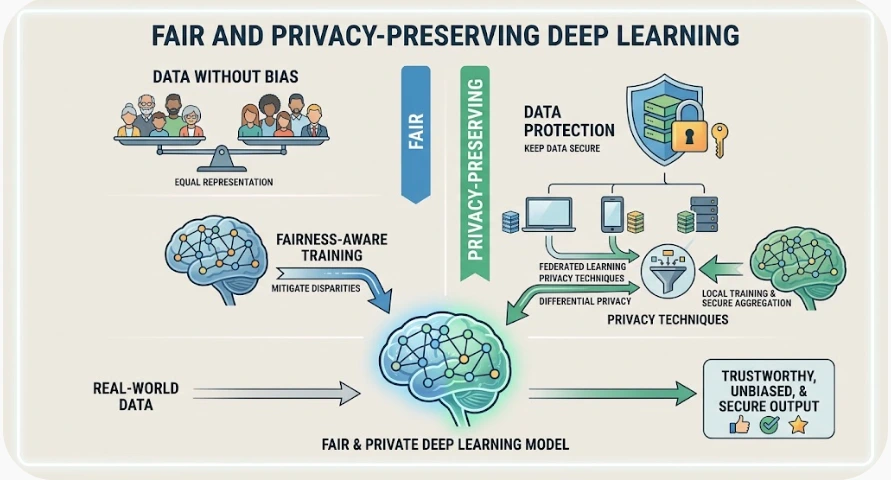
Federated learning trains an AI model across multiple local devices without moving or sharing private data. In its fundamental form, all contributors receive the same reward regardless of contribution levels. So, while Federated learning provides privacy, it comes at the expense of fairness. A simple analogy would be contributions by NATO nations to the alliance. Member nations contribute to NATO funds based on the size of their GDP. Yet, all member nations receive equal protection in times of war.
The FPPDL approach claims to solve the collaboration/contribution challenge by ensuring that each participant receives a final model with performance reflecting their individual contribution. Its definition of fairness is fundamentally flawed and inequitable for smaller participants. FPPDL's incentive design guarantees that larger participants can get higher performing models, while smaller participants get lower-performing, less accurate models because of the smaller volume of data contributed.
In the context of banks and financial institutions, if a FPPDL system is used to collaboratively train machine learning models to predict the creditworthiness of smaller companies, the subpar model used would mean a less accurate prediction tool, resulting in worse lending decisions. This would cause the banks and FI to be trapped in a cycle of being disadvantaged.
Furthermore, "mutual evaluation", in which banks score others' data quality to build "local credibility scores", introduces risks of collusion and systemic bias. Larger banks can easily undervalue smaller banks' data to suppress their credibility scores, effectively preventing them from forming high-value federated training pairs in each round.
When fairness is defined using equality rather than equity, those with more data become bigger and better while smaller data owners are systematically marginalised. With this, fairness is not necessarily achieved. It just legitimises market exclusion.